

Every year on May 1st, workers across the globe march, strike, and declare that their labor has dignity and their voices deserve to be heard. International Workers’ Day — or May Day, as it’s commonly known — is one of the most widely observed political holidays on earth, yet the United States, where it was born, does not officially celebrate it. Understanding why requires a journey back to 19th-century Chicago.
The Haymarket Affair and the Birth of May Day
In 1886, American workers organized a nationwide campaign demanding an eight-hour workday. On May 1st, hundreds of thousands walked off their jobs. Three days later, a peaceful rally at Chicago’s Haymarket Square turned catastrophic when a bomb exploded at that protest, killing one police officer and wounding others. Police opened fire into the crowd, resulting in the deaths and injuries of both police and protesters. Eight organizers were arrested for inciting violence. The ensuing trial was considered by many to be unfair and resulted in the execution of four of the eight men. The trial was widely condemned as a miscarriage of justice, and the Haymarket martyrs became symbols of worker sacrifice worldwide. In 1889, the International Socialist Congress designated May 1st as International Workers’ Day in their honor.
May Day and the Immigrant Rights Movement
May Day has always been inseparable from the immigrant experience. Many of the Haymarket organizers were themselves immigrants — German, Czech, and Eastern European workers who brought radical labor traditions from abroad. To tell the history of American labor without centering the immigrant worker is to tell only half the story.
Yet for much of the 20th century, organized labor had a complicated — and often shameful — relationship with immigrant workers. Powerful unions sometimes backed restrictive immigration policies, fearing that a desperate labor pool would be used by bosses to break strikes. Employers did exploit those divisions deliberately. But the response was too often to push immigrant workers out of the movement rather than pull them in — a fracture that served no one but the bosses.
The turning point came in the 1990s and early 2000s, when major unions like SEIU and UNITE HERE began organizing immigrant hotel, hospital, and food processing workers. Organizers discovered that immigrant workers were a crucial part of building greater worker power. They were often willing to risk everything for dignity on the job because many had already risked everything just to be here.
On May 1, 2006, that energy exploded into the streets. Millions participated in “A Day Without Immigrants,” responding to the Sensenbrenner Bill, which would have made undocumented presence a felony and criminalized anyone who assisted an undocumented person. In Los Angeles alone, an estimated 500,000 people marched. The message was clear: immigrant workers are the backbone of this economy, and they will no longer be invisible.
Today the stakes are even higher. Mass deportation campaigns and worksite raids have intensified, and employers routinely threaten to call immigration authorities when workers organize or report wage theft. That is the same dynamic that sent police charging into labor pickets more than a century ago. An undocumented worker who can be deported for speaking up is a worker with no power, and a worker with no power drags down standards for everyone. Deportation is, in a very real sense, the ultimate union-busting tool.
Why May Day Still Matters for Labor Unions
May Day is an annual reminder of what collective action has won — the eight-hour workday, the weekend, child labor laws, the minimum wage — and a rallying point in an era of low union membership and renewed attacks on workers’ rights. It challenges unions to keep broadening their vision: the incorporation of immigrant workers is not just a moral imperative, it is a strategic necessity. When unions march on May Day alongside immigrant rights advocates, they affirm that labor solidarity means solidarity for all workers, documented or not.
International Workers’ Day belongs to the immigrant and the native-born, the union member and the unorganized, the past and the future. On May 1st, the world remembers that the fight for dignity never truly ends — and that it is always strongest when waged together.
Stand together on May 1!
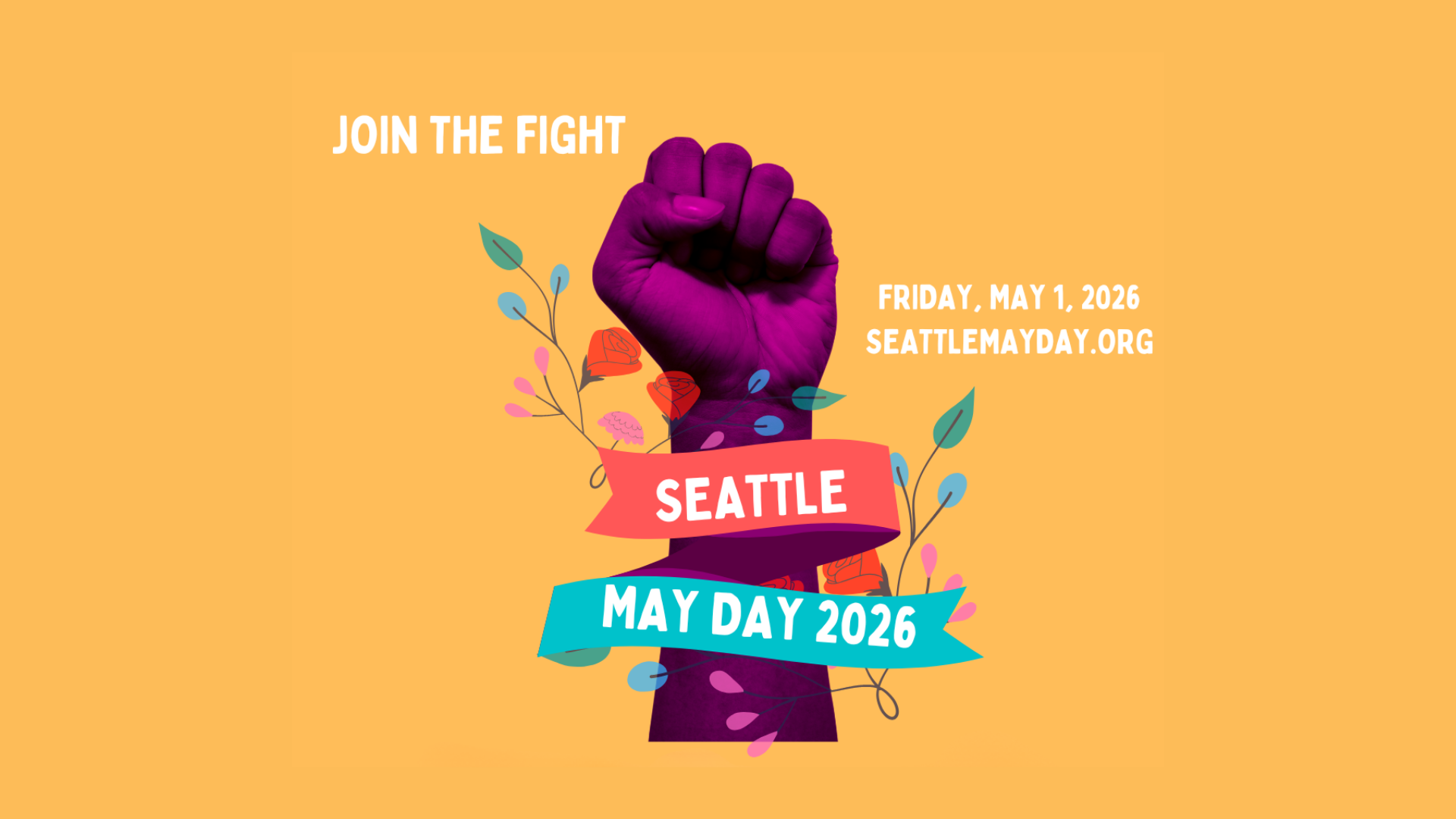
There are many May Day events happening throughout our region, including the large rally and march in Seattle starting at 12 p.m. on Fri., May 1 at Cal Anderson Park (poster pictured, this page). Check the PROTEC17 website (protec17.org) and our member portal (members.protec17.org) to find other May Day events in your area!